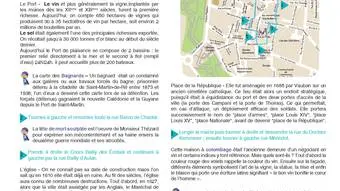
1 - Leave the Tourist Office towards the port and walk along the Quai Job Foran to the intersection with Rue Baron de Chantal.
Le Port - Wine and vines in general, planted by monks in the 12th and 13th centuries, were the region's first source of wealth. Today, there are 650 hectares of vines, producing
produce 30 to 35 hectoliters of wine per hectare, or around 2 million bottles a year.
Salt was also a major export. Up to 30,000 tons of white gold were harvested at the beginning of the last century.
Today, the marina comprises 2 basins: the first connected directly to the sea and the second afloat (filled with water) 24 hours a day. It can accommodate over 200 boats.
La carte des Bagnards - A bagnard was a convict sentenced to the galleys or forced labor in the bagne, a prisoner held at the citadel of Saint-Martin-de-Ré between 1873 and 1938, one of whom drew this map during his imprisonment. The convicts (prisoners) sailed to New Caledonia and French Guiana from the port of Saint-Martin.
2 - Turn left up Rue Baron de Chantal.
The sculpted skull and crossbones are the work of Monsieur Thézard, expressing his displeasure and hatred of World War II and its atrocities.
3 - Turn right into Cours Bailly des Écotais and then left into rue Bailly d'Aulan.
The church - We don't know when it was built, but we do know that by 1610 it was already in ruins. Over the centuries, the church has suffered many destructions. Firstly, in 1627, when the town was under siege from the English, Marshal de Thoiras (defender of the Ile de Ré) ordered his troops to raze the church's belfries to the ground to prevent the enemy from installing their cannons. In 1696, the Anglo-Dutch fleet dropped over 3,000 bombs on Saint-Martin, destroying over 300 houses and, of course, the church. In 1964, a fire broke out, completely destroying the roof structure and choir.
Despite all the damage, the people of Saint-Martin worked tirelessly to rebuild and renovate the church, which to this day remains the only Catholic place of worship.
4 - Walk up rue Bailly d'Aulan to Place de la République.
Place de la République - This was laid out in 1685 by Vauban on a former Catholic cemetery. At the time, it was a strategic location, equidistant from the harbor and the city's two gateways (the Porte des Campani and the Porte de Thoiras). In the event of an attack, this enabled soldiers to be deployed efficiently. It was successively named "place d'armes", "place Louis XIV", "place Louis XV", "place Nationale", before becoming "place de la République".
5 - Drive alongside the town hall, then turn right down Rue du Docteur Kemmerer, then left into Rue Mérindot.
This half-timbered house was once the home of a wine merchant, and there are some clues to this. But what are they? Firstly, the red shutters are reminiscent of the color of wine. Then, on the façade, various elements symbolize the art of winegrowing: the statue, the frieze and finally the coat of arms bearing a Latin script meaning "good wine improves the heart of man".
6 - Turn right onto rue Savary de Mauléon and walk down rue Jean Jaurès to the market.
7 - Le Marché - The covered market is built on a former Protestant temple, razed to the ground after the revocation of the Edict of Nantes.
Read more