
8 curiosities, stories and anecdotes in Rivedoux-Plage

1 – The Hastrel Manor

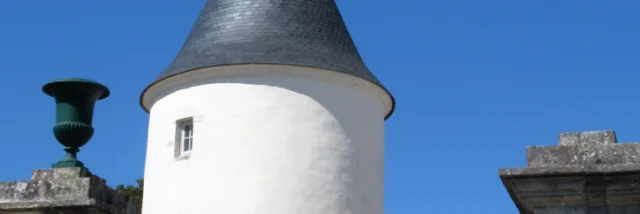
Of a surprising discretion, this manor house with its remarkable tower is the witness of the past of the future commune of Rivedoux-Plage. The first sources that mention it date back to 1480 when the lord of Ré, known as Louis Ist de La Trémoille, offered an estate located in the current village of Rivedoux to the local lord Jean I<sup>st</sup> Arnaud-Bruneau. No Hastrel in sight, but that’s normal. It was not until almost 200 years later, in 1681, that the Bruneau heiress, Marie, married the Lord of Vaillon, Jean-Baptiste Christophe d’Hastrel. It is easy to guess that it is in homage to the latter that the manor will take its definitive name. The manor house was large and had two courtyards separated by a dwelling and surrounded by several outbuildings. The whole was enclosed by a wall whose entrance was on the street. There was also a private chapel built in 1724, and the famous tower housing the staircase connecting the floors. The manor remained in the family for many years. It was not until 1845 that the manor was sold and the estate divided into several parts to different owners. Subsequently, each of the buildings underwent modifications, gradually removing the remains that remind us of the presence of a manor house on this site. The tower had lost its roof and remained bare for many years. It was only in 2006 that it was given what is known as a slate “pepperpot roof”. As it is a private property, you cannot visit the site. However, feel free to approach it by heading towards the port of Rivedoux on the aptly named Rue du Comte d’Hastrel. In fact, the village’s port is a legacy of the very first one dating from 1562 that Jean Ist’s son, Jean-Pierre Arnaud-Bruneau, is said to have had built.

This is not the only house on the island that stands out in the landscape of its commune. If you go to Ars-en-Ré, you may quickly notice another bourgeois residence with a tower, but this time suspended: the Sénéchal house.

Sources :

  • Demeure dite manoir d’Hastrel, (online) : https://www.pop.culture.gouv.fr/notice/merimee/IA00043195 [consulted on 23/11/2022]
  • LE LAY Stéphanie, Petit Dictionnaire du Patrimoine de l’île de Ré, La Geste, 2020, p. 135-136
  • ROQUES Hervé, WERDEFROY Yann, Île de Ré, petits secrets et grandes histoires – Guide du promeneur curieux, Éditions Sud Ouest, 2021, p. 9

2 – The Rivedoux fresco

This is one of the most recent curiosities of the whole island of Ré. Created during the summer of 2022 under strong heat, this fresco is a symbol of the life that one can imagine in Rivedoux, or elsewhere, between the beach and the market. Created by Maxence Texerault during his studies, the project aimed to embellish a wall of the village hall and to bring a little joy to the passers-by. The young artist did not take long to paint this colourful and lively fresco. Yes, this work was done during the summer only, but it also takes up elements of the daily life of Rivedoux which took place before the artist’s eyes. Let’s take the example of the little dog in the centre of the illustration. It is said to be that of a regular passer-by living in the village. The market scene, as well as the cyclist and the inhabitants at the windows, also give a welcome dynamism to the fresco which nevertheless contains a little fantasy. If you look closely, in the distance in the sea, between the kite surfers and our cyclist, you will notice that a particular creature is pointing its tail out of the water. This time, this sea monster would be a request from a very young admirer. So if you are passing by Rivedoux-Plage, don’t hesitate to stop in front of this joyful and colourful work to observe the smallest details, because there will surely be other secrets to discover.

This fresco is the result of a reproduction of a smaller drawing made earlier. Maxence had to redo it to the scale of the two sections of wall, each 3 metres long. To do this, a grid was first drawn in order to reproduce the original work on paper, but in a larger size.

Sources :

3 – The sculpture Des vagues, des mouettes (Waves, Seagulls)


When you stroll through Rivedoux-Plage, a contemporary sculpture stands proudly on the Esplanade de la Mer, as if to mark the other side of this square, opposite the market. Measuring an impressive 4.60 metres high and 2.50 metres wide, Des vagues, des mouettes (Waves, Seagulls) is the highlight of an open-air exhibition that aimed to redevelop the town centre through sculptural and architectural art: ‘Art’chitecture pour demain’ (Art’chitecture for Tomorrow). Made of bronze, brass, steel and recycled materials, the 18 sculptures on display illustrated themes dear to their creator: insects, musicians, the Hispanic world… And to complete this collection, a commission was placed to offer visitors a final steel creation on the theme of the sea. Installed in August 2011 by Casimir Ferrer, its sculptor, this work was intended to remain in place even after the one-year temporary exhibition. As its name suggests, the aim here is to represent waves, seagulls… and a disc that could remind us of the Sun. Or the moon – we’ll leave you to decide for yourself. It was during this exhibition that director Jean Becker decided to include certain works in his future film Bienvenue parmi nous. So, after the exhibition in March 2012, six of the sculptures were sent to the film set. It was no coincidence that they caught the director’s eye, as Casimir Ferrer is an internationally renowned painter and sculptor, whose creations now adorn city centres in France, Germany and Canada. It was therefore unthinkable for Patrice Raffarin, mayor of Rivedoux in 2011, and urban architect Alain Gry not to request their own sculpture by the artist for the village. This has now been accomplished.

At this famous exhibition, some sculptures also reached remarkable proportions. Examples include a 5-metre-high representation of Don Quixote, and ‘Contre vents et marée’ (Against All Odds), depicting a ship sailing on rough seas, which took its place on the esplanade with a height of 4.60 metres.


Sources :

4 – The Rivedoux Fountain

It’s a lovely, pretty fountain that awaits you in Rivedoux when you venture down the aptly named Rue de la Fontaine. Despite the fact that it looks brand new, you can imagine that it is not as simple as that. At least, the story of its origin and the well that goes with it. After all, who’s going to draw water from a fountain when you have running water at home? Perhaps the answer lies a little further back in time. In fact, at the end of the 1930s, the island was still a real island, with no bridge to connect it permanently to the mainland. So the people of Rivedous needed a way to get water. Only a few metres from this fountain, a small hand pump was installed. This pump was still used to distribute water for the whole village! It was located on a dirt road that was frequently used by carts and was used to fill the tanks for sulphating the vines. After the Second World War, refugees who had settled in Rivedoux offered the inhabitants an electric motor to automate the pump to thank them for their welcome. And fortunately, since the carts were more and more numerous. Then, around 1950, the road was tarred and the well disappeared, but without any major consequences since the households now had their own access to water. In 2008, the street was resurfaced and the well was brought back to life. Then, in 2009, the current fountain was built to symbolise this part of the village’s history. Does it work? Try it out on the spot.

Although Rivedoux only had a fountain, it also had a few wells which the inhabitants could use. You can see one at the corner of Rue Pasteur and Rue du Phare, a little further on. Moreover, there are quite a few wells in the other communes of the island which bear witness to this past.

Sources :

5 – The Sablanceaux Pier

You have surely seen it when you arrived on the island, standing on the shore opposite the port of La Rochelle. A witness to a bygone era, but not yet ready to end in gravel, the Sablanceaux pier is for many people an unforgettable childhood memory. And for good reason, for nearly 48 years it was the main link between the mainland and the island. But before it became what it is today, the pier was quite different. It was originally a wooden pontoon built around 1880 to replace a primary pier near the 13<sup>th</sup> century Châteliers Abbey, when the port of La Rochelle, La Pallice, was created. However, Mother Nature did not seem to approve of this project, since about seven years later, the sand was now blocking access to the ships at low tide. Never mind! In 1896, the Department bought the whole thing and extended it. But the sand kept coming back. So much the worse! A new pier was built a little further on in reinforced concrete and with an iron footbridge and inaugurated in 1909. But once again, the sand came to play the spoilsport by silting it up this time. Never mind again!  In 1928, it was extended so that it could be used again. And two years later, it was decided to set up a ferry system to make regular connections between La Rochelle and the Ile de Ré. This time, the sand was left alone. However, the German soldiers during the Second World War changed the situation. The new pier was built in 1940 and was designed to accommodate the vehicles that would leave the requisitioned ferries to transport goods and passengers. Then the war ended. But the pier continued to be used for another 43 years before the bridge, in 1988, allowed it to retire for good. And to top it all off, the sand made a comeback. Never mind again and again?

In 1987, for its last year, 680,000 vehicles made the crossing. But it was in 1965 that a record was broken: 1,643,077 passengers took the ferry. The island bridge more or less surpasses it every year without ever doing much more even though it is easier to use!

Sources :

6 – The Chauveau lighthouse

Yes, there’s more to the Île de Ré than just the Phare des Baleines! In fact, there are quite a few of them. And the very first one you see when you come to the island is our Chauveau lighthouse. Standing 30.7 metres high, it served as a landmark for sailors on their way to the port of La Rochelle, in a trinomial arrangement with the Lavardin turret and the Sainte-Marie bell tower. Built between 1839 and 1842, between Rivedoux and Sainte-Marie, it was no mean feat… In fact, in order to build only the foundations, it was necessary to wait for high tides, which meant that the construction time was exceeded! One of the engineers said that he had to wait until ‘February 4, March 15 and April 13’ in 1839 to be able to lay the foundations on the rock that serves as the lighthouse’s base. Located 1.2 km from the Pointe de Chauveau, the lighthouse could only be reached at low tide, making it difficult to complete, but it would be done 3 years later. Originally intended to be full, it was finally decided to make it manned. And in order to maintain it properly despite the hazards of rising tides, it was decided to provide 2 watchmen, despite the narrowness of the upturned trumpet-shaped tower. The tower was modernised several times, including in 1872 when a red light was installed to warn ships of danger. In 1874, it was decided to replace the mineral oil in the lantern with rapeseed oil, which was much more effective and made the light more intense. Six years later, a second red beam was added, before rapeseed oil was replaced by petroleum vapour in 1906. Then, on 16 September 1953, the prefecture authorised the installation of a manual sound signal to warn fishermen on foot of the rising tide, as too many accidents had been reported. Finally, in 1964, the lighthouse became black and white, then electrically automated 4 years later. Finally, the lighthouse returned to its original white and red colours, but still retains its period furniture and original lens with a range of 28 km. Although it cannot be visited, you can approach it at low tide.

A wind turbine has been installed at the top of the lighthouse to supply it with electricity. As the lighthouse is on the open sea, the system for converting wind into electricity is more efficient.

Sources :

  • LE LAY Stéphanie, Petit Dictionnaire du Patrimoine de l’île de Ré, La Geste, 2020, p. 131
  • BRUGIER Camille, À la rencontre de notre histoire… Le Phare de Chauveau, Rivedoux-Plage Town Hall, 2011, 19 p
  • ROQUES Hervé, Dictionnaire de l’île de Ré, Éditions Sud Ouest, 2023, p. 237

7 – The island’s ‘défens’


To avoid any confusion, please note that ‘Défend’ is the name of the property in question, and ‘défens’ is the name given to this type of estate. Now that this point has been clarified, let’s get started! South of Rivedoux, near the road leading to Sainte-Marie-de-Ré, stands a residence that cannot be missed. Lost in what looks like a marshy area, it stands at the end of Rue du Défend. And for good reason, as this is the ‘Défend’ in question! It is a large property that was extensively remodelled in the early 20th century and is surrounded by wet meadows and holm oak groves owned by the Conservatoire du Littoral since 1982. But why is it featured in the curiosities, stories and anecdotes section? Quite simply because it is one of the last remaining examples of rural residences built on the island in the 16th century. And as early as the end of the 12th century, we had evidence of the existence of this land under the name deffensum de Saboncelo when it belonged to the lords of Mauléon. Under the control of a lord, a défens was a wooded area reserved for its owner, where no peasant was allowed to graze their animals or collect wood. At the time, there was no residence there yet. However, this estate was ceded to the Abbey of Châteliers in 1190, before Raoul III of Mauléon left for Jerusalem on a crusade with Richard the Lionheart. It was finally in the 16th century that we find the first mention of an owner of a farm of Le Défend: Jehan de Conan, mayor of La Rochelle. At that time, the building was mainly used to manage the surrounding estate, but we know that it also reflected the wealth of its occupants, as it had, among other things, a dovecote. Like other parts of the property, the dovecote no longer exists today. Le Défend is thus representative of the country houses of formerly wealthy inhabitants, which were once quite common on the Île de Ré. We even know that they had high walls to defend themselves against potential looters. Is this the origin of the word ‘défens’? We do not have the answer to that question. As you might expect, this is private property and cannot be visited. But there is nothing to stop you admiring it from afar!

Another défens known to the inhabitants of the Île de Ré is the former residence of La Davière, at the western end of La Couarde. It was also a property surrounded by high walls, although only ruins remain today. It played an important role in the Battle of Feneau in 1627. But that clash is another story to be discovered among the curiosities of Loix.


Sources :

  • LE LAY Stéphanie, Petit Dictionnaire du Patrimoine de l’île de Ré, La Geste, 2020, pp. 138-139
  • ROQUES Hervé, Dictionnaire de l’île de Ré, Éditions Sud Ouest, 2023, p. 96
  • ROQUES Hervé, WERDEFROY Yann, Île de Ré, petits secrets et grandes histoires – Guide du promeneur curieux, Éditions Sud Ouest, 2021, p. 15

8 – The old district of Rivedoux

Did you know that Sainte-Marie was the island’s largest village until 1928? Today, it’s called La Flotte. Any idea why? This date is not insignificant, as it refers to the year in which the birth of a brand new village on the island was proclaimed: Rivedoux-Plage. Yes, there was a time when the village of Sainte-Marie, along with La Noue, which has been attached to it for some time, extended from Les Grenettes, as it does today, to Sablanceaux, where the bridge will proudly stand. For the record, La Noue, one of Sainte-Marie’s districts, wanted to be administratively independent of the original village for many years. Unfortunately, all attempts failed. Then, in 1904, Rivedoux, a rather distant district at four kilometres, also tried. As with La Noue, the town council and then the Council of State refused. Nevertheless, many supporters of the idea, including those close to the government, joined the battle for independence. And in 1928, Rivedoux officially became a new commune with the approval of the Senate and the Chamber of Deputies. It was the result of its division with Sainte-Marie and the granting of some land by La Flotte. But without a town hall, everything remained to be done. The town hall was finally inaugurated in 1937. And in 1972, the church was consecrated, after 44 years of having to travel to Sainte-Marie to pray. Rivedoux may have been around for a long time, but historically speaking, it’s still a very young town.

When the vote was cast in favour of Rivedoux, it was necessary to find a name that sounded like a “village”. Rivedoux-les-Bains was thought of but in the end Rivedoux-Plages was chosen. And if you think there’s a mistake above, it’s probably because when the name was made official, there was a small typing error with the final “s” missing, hence : Rivedoux-Plage.

Sources :

  • PRANDI André (publication director), RAFFARIN Patrice (editorial director), Rivedoux-Plage 75 ans Spécial anniversaire, 2003, 20 p., (online) : https://www.calameo.com/read/0001338711eb8b7281667 [consulted on 13/06/2023]
  • ROQUES Hervé, WERDEFROY Yann, Île de Ré, petits secrets et grandes histoires – Guide du promeneur curieux, Éditions Sud Ouest, 2021, p. 7-8