

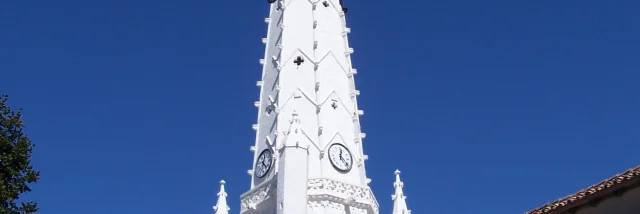
They are often large, often in the center of our towns and villages and were originally meant to be the largest buildings you could find. It is in France that this is still most true.
Inside, no one shouts and sometimes no one says a word. Besides, a place that doesn’t have one is called a hamlet.
In fact, we’re talking about churches 
And the island of Ré has 10 of them, just like its villages. But you should know that it wasn’t always that way. And at first, you don’t necessarily expect what follows. In addition to their sometimes surprising appearance, you’ll discover that some have little peculiarities that are well worth stopping by for a few minutes.
Incidentally, the word “church” is only capitalized when referring to the institution, not the place 😉
To make it easier for you to find your way around, we decided to list them in the same order as the villages, starting from the bridge, thus Rivedoux, to the point furthest from it in terms of distance: the Portes-en-Ré.
Feel free to click on each image to see them in detail. And don’t forget the magnifying glass to admire the portrait images 

Notre-Dame-de-Lourdes Church in Rivedoux
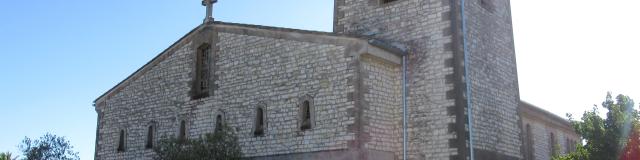
Church of Notre-Dame-de-Lourdes in Rivedoux
|
Effectively, in the history of the island, Rivedoux is the last among the villages since it officially dates only from 1928. The future plans for the church were slowly but surely made and the land was purchased in 1953. However, it was not until 1959 that the first project was discussed. As far as we know, the building was intended to be very different from the one we know today. The initial project mentions a simple church in exposed stone and white plaster with a tall and slender bell tower positioned on the right side, quite contemporary as a location. However, a project inspired by the old churches of the island was finally voted. It was not until 1963 that construction began, punctuated by a lack of funds, and 1972 that it was consecrated. All in stone, this place of worship now boasts a square, massive and low bell tower, reminiscent of that of Loix, for example. The layout of the church differs greatly from that of traditional and classical churches. The interior plan is rectangular, without chapels or other added spaces, and simple allowing everyone to see the priest. You will notice the different types of tiles that serve to delineate the spaces and their function, as well as a very modern geometric and concrete triumphal arch. As for the glazed decorations, it is part of the artistic movements of his time with cubism, fauvism, … as sources of inspiration.
Finally, for the anecdote, the two wooden sculptures of the church made in 1972 show Christ as well as the Virgin whose hands are joined, and not in a cross to save material.
⛪ Notre-Dame-de-l’Assomption Church in Sainte-Marie-de-Ré
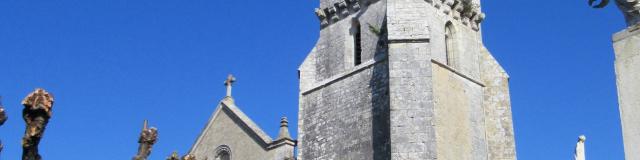
Church of Notre-Dame-de-l'Assomption in Sainte-Marie
|
It is possible to date the parish of Sainte-Marie’s from about the twelfth century according to many sources. However, we can see that the style of the base of the bell tower corresponds more to what was done in the 15th century. The fact that it also has military architectural elements such as machicolations confirms its status as a fortified church during the Hundred Years’ War that could shelter the population in case of need and also serve as a lookout. The building probably had ramparts and ditches to make it an even more effective place of refuge. Then, in 1684, the walls were destroyed at the request of the bishop of La Rochelle, as calm had returned. In 1699, it was the turn of the façade to collapse, accidentally this time. The reconstruction of the latter allowed the addition of two more doors to accommodate a growing number of faithful. All of this was done under the supervision of Pierre Tillorier, then the King’s contractor. In spite of regular maintenance, it is clear that in 1852, the repairs became urgent. The city council then decided to rebuild the church to avoid the loss of money and time due to successive recurrent works. It was then decided to enlarge the church and to rebuild its façade and choir. The neo-gothic style then took an important place in its architecture.
Interesting fact, the bell tower of Sainte-Marie was also used as a landmark for fishermen, like the one in Ars. The colors being white at the base of the spire, and black at the top.
⛪ Sainte-Catherine Church in La Flotte
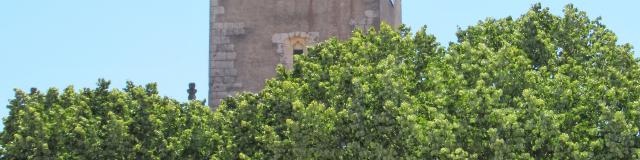
Church of Sainte-Catherine in La Flotte
|
Before the church we know, there was already another one that is described as primitive. Today, almost no trace of it really remains, except on the right wall near the entrance, and even then, one must be observant. It is the wars of Religions which will force the village to restore the church many times during the 16th and 17th centuries. But it is in 1632, that Sainte-Catherine is designated to receive a baptized bell offered by the cardinal of Richelieu, fighting at that time against the Protestantism present at the doors of the island, in La Rochelle, although this one had been subjected four years earlier. At the end of the 17th century, several renovations took place, but it was in 1741 that the building took on its current particular plan, notably because of the layout of the surrounding streets. When you arrive, you will surely have noticed its unusual façade. The reason is quite simple, in 1818, its architect gives it a neoclassical appearance, inspired by ancient architecture.
The church is also distinguished by its collection of stained glass windows dating from 1876, or its ex-voto of which one of the oldest on the island is its hanging model.
⛪ Saint-Martin’s Church in Saint-Martin-de-Ré
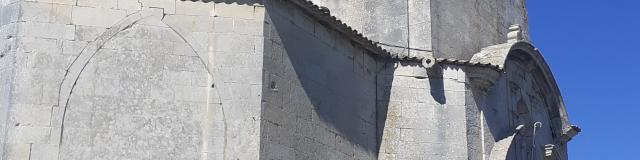
Church of Saint-Martin in Saint-Martin-de-Ré
|
It can be assumed, according to some sources, that Saint-Martin already had a religious building in the twelfth century, the presence of a priest in the village being established. However, we know with certainty that a church existed in the fifteenth century but did not withstand the conflicts of the seventeenth and ended up being totally destroyed, in view of the few remains that remained. The new church, the one we know, was built just afterwards in a Gothic style, not very present nowadays, but seems, according to its original plans, to have been reversed in the 18th century. It is also interesting to note that the church of Saint-Martin was fortified during the Hundred Years’ War, as evidenced by the remains of a sentry walk. At that time, the defense of the island is ensured by its inhabitants and only the churches were able to accommodate a whole village, hence its nickname of “Great Fort”. Its towers were used as watchtowers from which the view could extend up to thirty kilometers. In 1696, after a failed invasion, an Anglo-Dutch fleet took revenge from the sea by bombing the only visible part of the village, its church. Since then, the building, although renovated, has been weakened and many elements have collapsed, including the bell tower in 1774. The church was then rebuilt and its steeple was rebuilt nine years after the attack.
However, a fire hit the building in 1965 and reduced the roof structure to ashes, as well as the main altar. Nevertheless, the rebuilding work and the restoration of the furniture allowed the church to reopen after only one year. Also, like Ars, it had its black and white tours in the past.
The Church of Tous-les-Saints in Bois-Plage
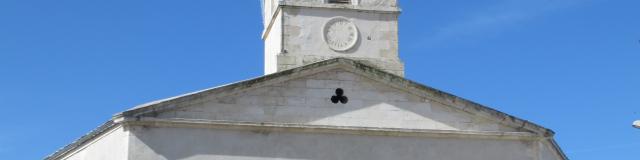
Church of Tous-les-Saints in Bois-Plage
|
The first traces of a religious building in Bois-Plage probably date back to the 15th century. Difficult nevertheless to affirm if it is a chapel or a church. But time goes by and the place becomes more and more dilapidated and less and less able to welcome all the Boitais, always more numerous. It was not until the 19th century that the inhabitants finally had the place of worship they had wanted for a long time, thanks to the enlargement of the building. Reconstruction projects followed one another between 1823 and 1832 to finally come up with plans that everyone could agree on. The work was extremely late and the builder took liberties that turned out to be somewhat bad. These defects lead to the fall of the triumphal arch of the choir and then a part of the tribunes between 1835 and 1836, the walls being in a deplorable state of solidity. In spite of these setbacks, the church finally succeeded in being built in a neo-classical style that was in perfect harmony with the refined fashion of the time. As you approach the choir, you can also see a series of paintings representing holy figures. They were done by one of the priests, Father Clatz, in 1905, the year of the separation of the Church and the State.
Finally, you will surely have noticed the rather original shape of the church if you are one of those who observe the smallest details. Indeed, the plan of the latter grants it a more trapezoidal aspect than truly rectangular to match the physiognomy of the streets that surround it.
⛪ The Church of Notre-Dame-de-l’Annonciation in La Couarde

Church of Notre-Dame-de-l'Annonciation in La Couarde
|
In 1850, the church of La Couarde suffered the catastrophe of too much. After numerous degradations during the 19th century, the roof of the building completely collapsed. The mayor of the commune had to quickly find a solution to allow its inhabitants to worship with dignity. An architect was appointed to rebuild the church in the centre of the village. The task proved difficult as the urban fabric made the plot narrow and slightly atypical and the reduced budget did not help either. No less than seven projects were presented to the municipality and the diocese in ten years. But it took another five years for the plans to be confirmed. The neo-Gothic church of La Couarde has a largely reduced choir in favour of a more prominent nave. The bell tower-porch is also distinguished by its advancement, which allows you to pass through all of its sides. So don’t hesitate to look up to admire its starry ceiling!
As for the inscription on its façade: “French Republic” and “Liberty – Equality – Fraternity”. You should know that it dates from 1905, when the Church and State separated. Another hypothesis evokes 1889 when, according to the latter, the mayor of the time decided to celebrate and durably mark the centenary of the French Revolution. However, we do not have enough sources to confirm this.
Sainte-Catherine Church in Loix
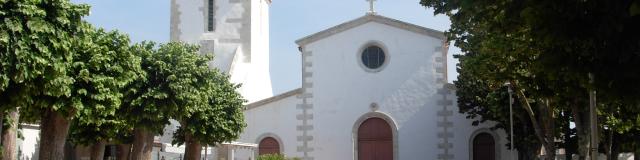
Church of Saint Catherine of Loix
|
Although the parish of Loix was founded at the beginning of the 14th century, its church is thought to be more recent, probably due to the turmoil present throughout the kingdom of France. Plans dating from 1827 inform us that the entrance was as usual: under the bell tower. Today, we can still identify the location of the walled entrance by the presence of a lintel above which stands a coat of arms indicating the abbreviation INRI of the Latin expression “Iesus Nazarenus, Rex Iudeorum”, which can be translated as “Jesus of Nazareth, King of the Jews”. In the 19th century, it was decided to renovate the church as we know it today, with its entrance on the “side”. Inside, there are also several ex-votos, including one of the oldest on the island: a naval model of the Gift of God, and one of the most recent: a model of the Tikocco, whose real ship suffered a storm in 1979, resulting in the death of nineteen of its sailors.
Finally, the separation of Church and State in 1905 will literally mark this building, which will see its facade flanked by the medallion “RF” for “République Française” and its famous motto “Liberté, Égalité, Fraternité”. With the church in La Couarde, it is the only two churches in Charente-Maritime to have had this inscription in 1905, which is exceptional, given their geographical proximity.
Saint-Etienne Church in Ars-en-Ré

Church of Saint-Etienne in Ars-en-Ré
|
A true symbol of the village, the church of Saint-Etienne was also the symbol of the island on which it was built before the island of Ré became one and indivisible. It was in fact in the 11th century that the building was built under the supervision of Vendéen monks on what was known at the time as the island of Ars, a Vendéen land. Not much remains of this first building; only three walls once constituted its nave. It is from the following century onwards that the church changes radically to adopt its current cross-shaped appearance. In the 12th century, it took on a more Gothic appearance, in line with the new architectural movement. Don’t hesitate to go to the west portal to admire its arch, or voussure, which is superior to the others, to see all sorts of vegetal, geometric and even fantastic representations with its centaurs, griffins and other chimeras. Then, during the Hundred Years’ War (1337 – 1453), it is known that the church was fortified by the Vendéen monks to protect it from a potential attack by soldiers of the British crown. The remains of these protections were used to pave the monument long after the conflict. As for the famous spire of the church, which rises to at least 40 metres, you should know that it dates from the 17th century, but its colours from the 19th century, like the new sanctuary which is attributed to it, greatly enlarged it.
Moreover, this black and white spire is not just coloured to look pretty. In the past, it served as a landmark for sailors, like a lighthouse. It is said that even in the worst weather you can see it from the sea.
⛪ Saint-Clément’s Church in Saint-Clément-des-Baleines
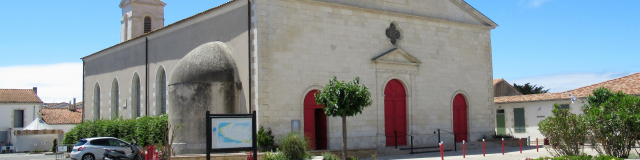
Saint-Clément Church in Saint-Clément
|
1830, Saint-Clément had, according to some sources, only a chapel, notably provided for services relating to burials. The only way for the inhabitants to attend religious ceremonies was to go to Ars-en-Ré. After repeated trips to Ars-en-Ré, the somewhat irritated inhabitants decided to have their own church built, although no authorization was granted and financing was non-existent. However, the vicar of Ars, Jean Bobard, was delighted with the idea and traveled all over the west of France to collect the necessary funds to build the church. And in 1843, Saint-Clément finally had its own church. However, it was not until March 31, 1844 that the village parish was established by royal decree. Then, a new tax, accepted by the parishioners, was introduced to pay off the debts resulting from the construction of the building. As for Abbot Bobard, he continued the quests to support the villagers. However, in 1847, the bell tower of the church collapsed and the abbot, Pierre Bobard this time, left for Chile in Valparaiso, to collect. Despite this, Saint-Clement had to wait 11 more years for the bell tower to be reborn on the plans of an architect from La Rochelle.
In a style that merges neo-Gothic and neo-classical, the church boasts an altar of black, pink and white marble and can boast two ex-votos under glass on either side of the entrance to the choir.
Saint-Eutrope Church in Les Portes-en-Ré
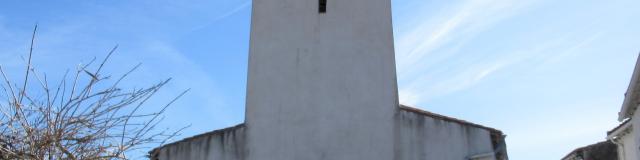
Church of Saint-Eutrope in Les Portes-en-Ré
|
The expansion of the marshes at Les Portes-en-Ré was to have many consequences, including the creation of its parish in 1548. For the time being, only a chapel served as a site of recollection. The vicars of Ars often held services there. Then, during the Wars of Religion, the first church of the village was plundered and irreversibly damaged, forcing the inhabitants to build a new place of worship. In 1629, the new building was built but quickly became too small to accommodate the entire parish, even if a gallery was added. At the end of the 17th century, the decision was made to modify the plans and layout to make up for the lack of space. The nave was lengthened, a chapel was added inside and the bell tower was built. The furnishings were also renewed or modified, such as the winged tabernacle dating from the 1630s, which is one of the oldest decorative elements still found in a church on the island. All the changes made at the very end of the 17th century as part of the Counter-Reformation, designed to deal with the Protestant reformation, will lead to the renewal of the blessing of the building in 1701.
Once inside, stop for a moment to admire the painting present on the vault of the chancel which has the particularity of having been made by the parish priest Moulard in 1925.
Bibliographic sources
- AOUSTIN Agathe, LE LAY Stéphanie, Le patrimoine religieux de l’Ile de Ré, 2018, Communauté de Communes de l’Île de Ré, pp. 191
- LE LAY Stéphanie, Petit dictionnaire du patrimoine de l’île de Ré, 2020, La Geste, 207 p.